












Repair guide
Why Sarasota’s Driest June in 132 Years Is Cracking Your Deck — and the 12-Month Fix
Got it — we will get back to you.

Walk out onto your deck this weekend and run a hand across the boards. If the wood feels rough, looks silver-gray, or shows thin cracks running along the grain, the drought did that — and it’s doing it faster right now than any summer rain ever did.
The drought is the reason, not the exception
Southwest Florida is in a Modified Phase III (Extreme) water shortage, extended through October 1 — the first declaration of its kind since 2017. Manatee County just logged its 4th driest June in 132 years of records. Sarasota is having its 31st driest year in that same span. At the time of the declaration the region sat 13.7 inches below normal rainfall.
That matters for your deck because pressure-treated pine and cedar are hygroscopic — they pull in and release moisture with the conditions around them. On a 90-plus degree July afternoon the boards dry out well below their normal moisture level. Then a 3 p.m. thunderstorm rolls in off the Gulf and they reabsorb water fast. Every dry-out-then-soak cycle stresses the surface cells until they fail, and small cracks — called “checks” — open along the grain.
Pressure treatment doesn’t stop this
A lot of Bradenton and Lakewood Ranch homeowners assume pressure-treated lumber is protected. It is — against rot and insects. It does nothing against weathering. UV radiation breaks down the lignin that holds the wood surface together, and in our sun that surface oxidizes to gray within 12 to 18 months. With the UV index routinely hitting 10 or 11 and salt air on top of it, SWFL is about as hard on exposed wood as anywhere in the country.
The bead test: two minutes, no guessing
You don’t need a moisture meter to know where you stand. Sprinkle a little water across the deck boards. If it beads up, your sealer is still working. If it soaks in within a few seconds, the seal has failed and the wood is drinking up every drought-and-storm cycle unprotected. Run the same test on your fence posts and rails — the south- and west-facing sides usually fail first.
The re-seal cadence for coastal SWFL
Here’s the schedule we work to on the Gulf Coast:
- Open, south- or west-facing decks: about every 12 months
- Shaded or covered decks: up to 24 months
- Fences: same 12–24 month range depending on exposure
If your deck failed the bead test and it’s been more than a year, it’s due.
Oil-based penetrating stain for checked boards
Once boards have started checking, the product matters. A film-forming sealer sits on top and peels as the checks flex; a penetrating oil-based stain soaks in and flexes with the wood. For drought-checked decks, penetrating oils are the pick: Behr Premium Semi-Transparent Penetrating Oil-Based Stain, Thompson’s WaterSeal Penetrating Timber Oil, and Cabot Australian Timber Oil. Behr’s water-based Premium Semi-Transparent Waterproofing Stain & Sealer works well on decks that haven’t checked yet.
One honest note on coverage: the label says 250–300 sq ft per gallon, but drought-dried wood is thirsty. Real-world coverage on a stressed deck is closer to 150 sq ft per gallon, so a typical deck needs 3–4 gallons, not one.
Apply before 10 a.m. — here’s why
This is the part most weekend DIY jobs get wrong. By 11 a.m. in July, deck surfaces in full sun hit 120°F. Stain applied to hot wood flash-dries at the surface before it can penetrate, so it never actually soaks in and it fails early. They start after the dew burns off, around 7 to 7:30 a.m., and local pros are done applying before mid-morning. Quick check you can do yourself: press your palm flat on the boards — if you can’t hold it there for three seconds, it’s too hot to stain.

Timing matters on the back end too. Afternoon storms fire by 2–4 p.m., and the stain needs 4–6 hours of dry time to cure. That early-morning window is the only reliable one this time of year.
What the job involves
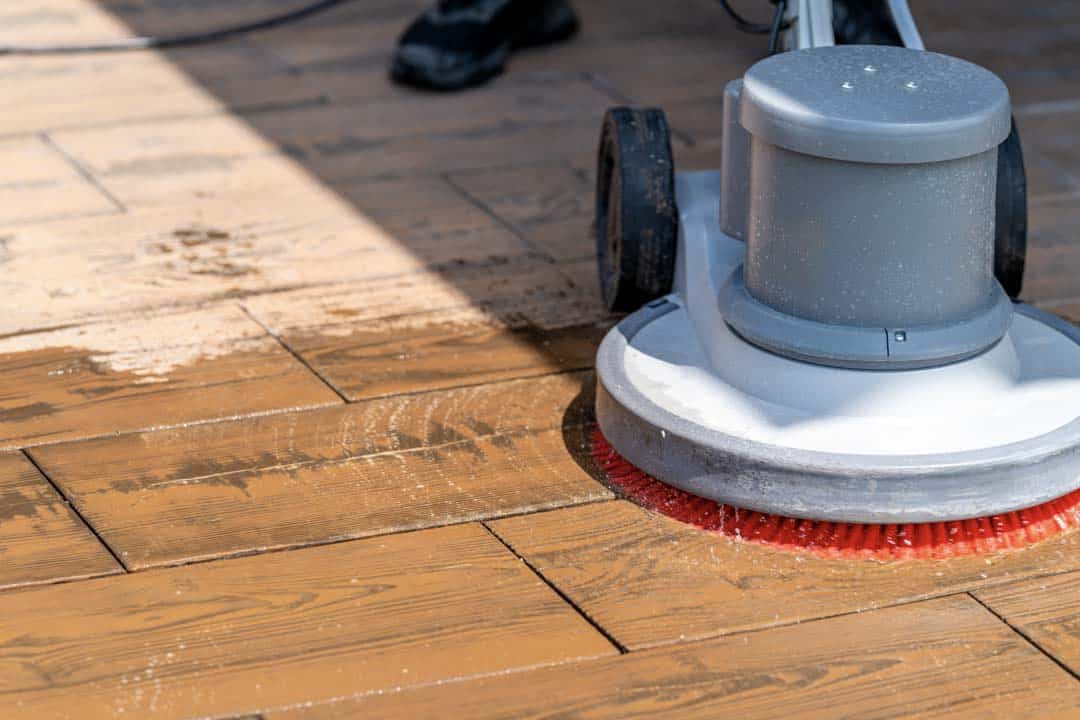
For a typical 200–300 sq ft deck, expect power-washing and prep to run 1.5–2 hours and application (1–2 coats) another 1.5–3.5 hours. That’s roughly 3.5–5.5 hours on site, usually split across two visits: wash and prep one morning, stain the next dry morning. Stain quantity depends on the deck size and how thirsty the wood is.
What the pros do and don’t do here
We re-seal and re-stain existing decks and fences. We’re not doing structural deck rebuilds, in-ground post replacement, or building a fence from scratch on this service — if the framing or posts are the problem, we’ll tell you straight and point you to the right trade.
If your boards failed the bead test, send photos for a quote at handys.now or call 941-207-6969 — we’ll have a number, and we can usually get on the schedule before the next storm cycle turns the deck into a sponge.
What sets the price
Contractors set their own prices, and prices vary. The size of the job, the materials you pick, access, the condition of what is there now, and any HOA or permit needs set the scope and the price. The pro quotes after seeing photos or the job.
A vetted local pro looks at the job and quotes before work starts.